

1.5K
Downloads
17
Episodes
What would it be like to grab a brewski with Bishop Lancelot Andrewes? Fr. Michael and Fr. Allen of St. Michael the Archangel Anglican Church Charolette invite you to the table for a drink and to discuss the works of this quintessential Anglican and famous Caroline Divine in order to see what he would have to say about the world in which we live.
Episodes
Nov 30, 2020
Nov 30, 2020
1 hr 6 min
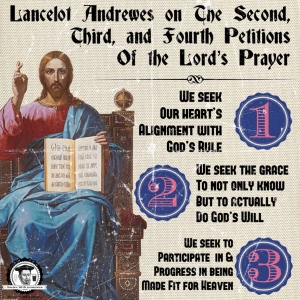
Episode Seven: The Lord’s Prayer, Pt.2
Andrewes on Establishing God’s
Heavenly Honor, Kingdom, and Will on Earth
Nov.14, 2020
Special Guest: Bishop Chandler Jones
Sermons 10 - 12 of Lancelot Andrewes’
Nineteen Sermons upon Prayer in General,
and The Lord’s Prayer in Particular.
.
Copies can be found in Lancelot Andrewes Works,
Sermons, Volume Five, or on The Project Canterbury Website.
Summary:
With the 4th, 5th, and 6th sermons of this 13-sermon collection on the Lord’s Prayer, Andrewes teaches on the often over-looked, or unconsidered, realties contained in the intentional wording of “Thy Kingdom Come” “Thy Will Be Done,” and “In Earth as it is In Heaven.”
Outline:
- “Thy Kingdom Come”
- Seek first the kingdom of God/heaven (“Thy Kingdom”)
- By seeking the renewal of our minds by God’s Spirit of Wisdom and understanding (cf.Isa.11:2; Rom.12:2; Eph.1:27).
- By seeking the renewal of our hearts and learning to contemn, and live for more than, earthly pleasures, our own selves, and this mortal life.
- Aspects of God’s Kingdom
- It is a Universal Kingdom, with God reigning over all things, kings, rulers, and nations (cf.Ps.99)
- It is a Kingdom of Glory (referring to God’s outer power and protection)
- Against this, the Kingdom of Satan seeks to rule the world in God’s stead,
- The Kingdom of Sin pushes back against the glory of God’s Kingdom, and
- The Kingdom of Death pushes back against the power of God’s Kingdom.
- It is a Kingdom of Grace (referring to God’s inner working)
- This part aspect of the Kingdom grants the New Birth to those who desire it,
- Roots out the presence of Satan’s Kingdom of Sin and Death, and
- Produces the virtues of righteousness, peace, and joy.
- The Nature of Its Coming
- When it comes, it reveals our corrupted appetites for the things of this world,
- It lightens our blind eyes for us to be able to walk in God’s ways,
- It inflames/enlarges our hard hearts to love God’s ways (cf.Ps.119:32)
- It removes from our lives all that offends God, and
- Its fullest coming will be at the eschaton (Bliss for some and Hell for others):
- We enter the Kingdom of Grace now that we might enter the Kingdom of Glory;
- Those who do not become acclimated to God in His Kingdom of Grace will find the coming of His Kingdom of Glory dark and torturous.
- Seek first the kingdom of God/heaven (“Thy Kingdom”)
- “Thy Will Be Done” (not just known, but done)
- We are seeking the grace to “Do”
- We seek God’s grace to reign in us now that we might reign with Him in glory.
- It’s not about calling Jesus Lord, but serving Him as Lord. It’s not about wishing, or desiring, but doing.
- We are seeking that God’s Will would become our own will by submitting to His hidden/secret will and framing our actions to His revealed/open will:
-
God’s Hidden/Secret WillGod’s Revealed/Open Will
- For His Pleasure
- What He wills
- Knowable only to Him
- Irresistible
- To be adored (election/reprobation)
- Passive (kept with or without our intention or awareness)
- In regards to the Secret Will we pray that nothing God’s commands will displease us and that nothing we do displeases Him:
- Anything not plainly spelled out can be dissented to
- It is possible in good will to desire something else than what God wills secretly (e., death of a loved one)
- It is possible in ill will to desire to do something God has willed not
- Disclosed to us
- What we ought to will
- Knowable and to be searched by all
- Resistible (thus we pray to be able to do it)
- To be studied
- Active (must be made aware of and intentionally acted upon)
- In regards to the Open Will we pray that when God does reveal His Will, we will have what it takes to see that it is done:
- Be it death,
- Be it trials and tribulations, or
- Be it His commands,
- We pray we might do it well
-
- We show our desire for God’s Kingdom by our obedience to His Will.
- Requirements for doing God’s Will
- We must lay aside, seek the conversion of, and discipline of our own wills for God’s Will
- We must acknowledge and honor God’s Will as being superior to our own in wisdom, knowledge, goodness, and sovereignty since ours, due to mortality, is blind, foolish, sinful, and in need of guidance.
- We must seek God’s grace and power not only to change our thoughts and desires but also our actions:
- God’s Passive Grace – that which awakens us to life from above.
- God’s Active Grace – that which accomplishes our new way of living.
- We are seeking the grace to “Do”
- “In Earth as It is in Heaven”
- As an Appendix to the First Three Petitions this shows us that it is not just about doing the action of hallowing God’s Name, spreading God’s Kingdom, and doing God’s Will, but equally about how, and in what manner, these actions are done.
- A Qualification: How God’s Will is Done Within Heaven and What That Means for the Way We Pray:
- Just as the three Heavens of Nature (weather), Heavenlies (sun, moon, and stars), and Throne Room (God, the Angels, and the Saints) obey the will and commands of God, so
- We pray that
- Heaven can use us to bless the earth like the weather
- The earthly Body of Christ (the Church) would match its Heaven Head (the ascended Christ)
- We might be like the angels ready to do God’s Will
- We follow the examples of the saints in heaven, becoming saints in the earth and bearing the heavenly image
- We will obey heaven’s Will even when it strikes against our natural inclinations:
- Like the Sun and Moon which stopped for Moses
- Like Christ who laid down His mortal life
- Like the Angels who willing leave heavenly bliss to help those on earth
- Like the martyrs who want vindication no but wait (Rev.6:10-11)
- Not like the demons who do it begrudgingly
- An Elevation of the Soul: Seeking the Things Above
- We seek progression in this life and perfection in the one to come
- We make it our present intention to walk in heavenly likeness.
- An Application:
- As we pray for the Will of God to be done, we must seek to perform it once it is revealed to us – both the Micro, Particular Will for us (personal sanctifications) and the Macro, General Will for all (patience under suffering)
- We must not postpone our spiritual lives thinking we will do it in the future.
- We must seek God’s will for our own countries where God has placed us.
Music & Sound Attributions:
Music in this episode by Blue Dot Sessions “Lost Shoe” (www.sessions.blue). Sounds used are as follows: “Beer Can Opening” recorded by Mike Koening found at (http://soundbible.com/216-Beer-Can-Opening.html) and “Pouring Drink” recorded by Mike Koenig found at (http://soundbible.com/2115-Pouring-Drink.html).
Oct 21, 2020
Oct 21, 2020
1 hr 9 min
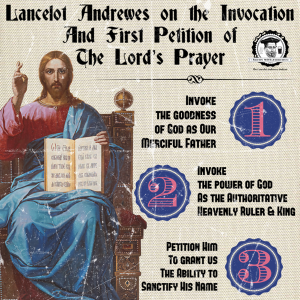
Episode Six: The Lord’s Prayer, Pt.1
Andrewes on Understanding God as Our Father in Heaven
And Sanctifying His Name
October 3, 2020
Sermons 7 - 9 of Lancelot Andrewes’
Nineteen Sermons upon Prayer in General,
and The Lord’s Prayer in Particular.
Copies can be found in Lancelot Andrewes Works,
Sermons, Volume Five, or on The Project Canterbury Website.
Summary:
With these first 3 sermons of the 13 sermon collection, Andrewes teaches on the often over-looked, or unconsidered, realties contained in the intentional wording of “Our Father,” “Which art in Heaven,” and “Hollowed be Thy Name.”
Outline:
- “Our Father” (Connecting to the perfection of God’s goodness and merciful nature)
- Benefits of Praying to God
- The guarantee of being heard when we prayer
- The gift of being able to pray to God as “Father”
- It reinforces our trust in God’s goodwill and favor toward us
- It balances our experience of kingly fear with bold confidence (Kingship implies His ability to answer prayers; Fatherhood implies His willingness to answer those prayers for us).
- Ramifications of having God as “Our Father”
- Calling God “Father” demonstrates the love we bear to Him
- Calling God “Our” demonstrates the love we bear toward our neighbor (other children of God)
- Knowing God as “Father” assures of His favor and gives us hope
- Challenges to accepting God as “Our Father”
- His Majesty ≠ our baseness (having been made from dust and ashes)
- His holiness ≠ our sinfulness
- Christ authorizes and enables us to call God “Our Father”
- We are given an exalted position above the Patriarchs and Heavenly Spirits
- By returning to God through the unique Son, we are given a unique relationship
- God as “Father” speaks of and acknowledges His affection for what He has made
- He is the Father of all creatures
- He is the Father of humanity, which He created in His own image
- He is the Father Who prepared the way back for His fallen children
- He is the Father of the New Birth granting us sonship
- As “Father” God’s affection toward us is shown to be immutable and excellent
- His fatherly love for us is unchanging in both chastening and blessing
- His fatherly love for us is excellent and abounding in forgiveness and mercy
- Additional benefits of God’s affection toward us being fatherly:
- It doesn’t take much to satisfy a Father’s anger
- There is a plentiful bounty of mercy
- We share in the inheritance He has prepared for His Son
- Out duty and response to God as “Our Father”
- To live as becomes His children and to repent/return to the Father when we haven’t
- To seek to grow up fully through His glorification/theosis as sons of God
- Respectfully reverence Him as our “Father”
- Realize all these benefits apply to everyone who refers to Him as their “Father”
- Pledge our love to all other brethren who say “Our” Father
- This fights against pride
- This prevents malice
- This teaches us to pray for others (fellow believers, those in open rebellion to God and their neighbor, and even our enemies).
- Benefits of Praying to God
- “Which Art in Heaven” (Connecting to the excellency of God’s power and greatness)
- This phrase is meant to be and expression of the Father’s greatness and power more than a description of the location to where the prayer is being sent.
- The phrase is used to temper the boldness gain by the idea of God as “Father” and to maintain a balanced understanding of God (He is both merciful Father and powerful rulers).
- The phrase is used to increase our confidence and faith in God because, like heaven, He is immortal, immutable, and able to give that which is incorruptible.
- The phrase serves to prepare us for prayer by making us to look upward in our desires.
- The phrase serves to focus us upon asking for heavenly gifts and blessings
- The phrase serves to beckon us to discover our true selves which were meant for that heavenly country
- In desiring to be in heaven, we begin to desire wanting to learn its ways
- In desiring heaven, we begin to desire wanting to be in the LORD’s Presence
- In desiring heaven, we begin to desire wanting to live under the Father’s roof/rules/will
- The phrase serves to remind us of our duty to be heavenly children of our heavenly Father.
- "Hollowed Be Thy Name"
- Praying for the ability to sanctify God’s Name is the 1st Petition to be sought in prayer
- It is a prayer to be enabled to have a reverend regard for God’s Name
- Therefore, it must come before even requests for the Kingdom
- Such regard distinguishes true worshippers from the rest because His Name conveys holiness to that which bears it. Such as:
- People (like the Old Testament priests or Paul in the New Testament)
- Places (like the house of God)
- Times (like sabbaths and feasts kept holy to the LORD)
- Proclamations (like preaching in God’s Name)
- Sacraments (like the Old Testament Bread of Presence or the New Testament Eucharist)
- Our regard for those things or persons which bear the Name demonstrate our estimation of God Himself
- Only the sanctified can sanctify the Name
- The duties that pertain to sanctifying the Name
- Pray not to misuse it
- Either by slip of the tongue or through contempt
- Sins of the heart: to speak inappropriately of the Name is equal to the action of treating God inappropriately (much like the relationship of lust and adultery)
- Pray to use it rightly
- In our hearts
- On our tongues
- By our actions
- Pray that others might do this, that all places may do this, and that all times may do this
- Pray that people will come to know His Name
- Pray that people will come to profess, worship, and honor His Name rightly
- Pray for those who once professed, worshipped, and honored His Name rightly may repent and do so once again
- Pray that God’s Name might get the glory alone
- Not ourselves nor other men
- Not those who, or things that, bear the Name in themselves apart from God Himself
- Prayer that people will be given the “Fear of God”
- Knowing their unworthiness
- Blessing God for His goodness
- Telling others of His goodness
- Praising God for His goodness
- Praise and Bless His Name for our Sanctification
- Remember that if we have the desire in us now to glorify His Name, He will not deny us the place to do it eternally.
- Pray not to misuse it
Music & Sound Attributions:
Music in this episode by Blue Dot Sessions “Lost Shoe” (www.sessions.blue). Sounds used are as follows: “Beer Can Opening” recorded by Mike Koening found at (http://soundbible.com/216-Beer-Can-Opening.html) and “Pouring Drink” recorded by Mike Koenig found at (http://soundbible.com/2115-Pouring-Drink.html).
Sep 7, 2020
Sep 7, 2020
58 min
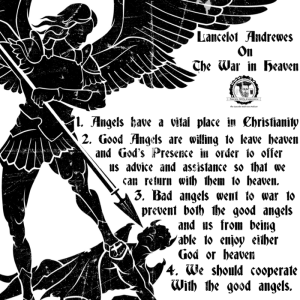
Episode Five: That War in Heaven
Andrewes on the Role of Angels in Revelation 12:7 and the Bible
Recorded August 29, 2020
Sermon 13 of Lancelot Andrewes preserved in A Collection of Posthumous and Orphan Lectures preached by him in the Parish Church of St. Giles outside Cripplegate, London on the Feast of Saint Michael and All Angels, September 29, 1599.
A copy can be found in Apospasmatia Sacra, or on The Project Canterbury Website.
In this sermon, Andrewes expounds upon the Twelfth chapter of St. John the Divine’s Revelation which tells about the war fought in heaven between the forces of Michael and his Angels and the forces of the Dragon and his Angels, using it to explain both the roles of all Angels in the life of the Church and her believers as well as the congratulations due to God and these Angels that should be offered by the Church and her believers. A detailed outline is as follows:
- Introduction: Angels in the Christian Faith
- The Christian Faith neither worships nor dismissed Angels and the spiritual realm
- Adoration and worship are due solely to Jesus Christ ( Col.2:8; Rev.22:9)
- Acknowledgment and respect are due to His heavenly host ( Act.23:8; Gen.28)
- The Christian Faith includes a thankfulness to God for the roles His Angels play and a giving of congratulations to them for their service
- The Christian Faith neither worships nor dismissed Angels and the spiritual realm
- Who are the Angels
- Beings who willingly leave the bliss of God’s Presence in heaven to serve those on earth by taking charge, protecting, and ministering to believers ( Matt.18:10; Ps.16; 91:11; Heb.1)
- Beings who willingly leave the glorious Presence of God’s company for the sinful, corrupt presence of creatures formed with clay (Job 4; 17:14)
- BIBLICALLY SPEAKING: the word “angel” is a title for a spiritual being who has been given a task by the LORD. Any of the invisible beings spiritual of the spiritual realm: Serephim, Cherubim, Thrones, Dominions, Watchers, Princes, Powers, Principalities, Sons of God, Holy Ones (lit.hagios/saints) and even the second Person of the Trinity can serve as an “Angel.”
- What Advice and Assistance They Offer
- They offer direction, knowledge, understanding, council to God’s people ( Gen.31:11; Dan.9:22; Rev.1:1)
- They encamp around God’s people and wage war against both evil men and angels on behalf and in defense of the righteous so that they may overcome the adversary (Ps.34; 2Kng.6:17; Ps.35:6; Exod.12; Isa.37; Ps.91:13)
- Why We Celebrate them on St. Michael’s and All Angels
-
- We Celebrate their Great Battle Against and Victory over the Dragon
- Michael
- Michael serves under Christ taking charge over the Church on earth (cf.Dan.10:13,21)
- Michael serves under Christ keeping the devil in check (cf.Jude9)
- Michael serves under Christ as the chief spirit among the created spirits (cf.Rev.12:5)
- The Dragon
- The Dragon is none other than the Slanderer of old [Hbrw: Satan & Grk: Devil] who is shown to both slander the LORD’s goodness to man (Gen.3) and man’s goodness to the LORD (*Job1*).
- BIBLICALLY SPEAKING: in the Old Testament “Satan” or “the Satan” is never used to speak of the chief rebel of the Bible, but during the Second Temple period when God’s people began trying to understand the evil they were experiencing in the world from a Biblical perspective this idea developed. See below.
- The Dragon is the chief enemy of both the good (Rev.12:13,17) and the bad (Rev.12:9)
- The Dragon is none other than the Slanderer of old [Hbrw: Satan & Grk: Devil] who is shown to both slander the LORD’s goodness to man (Gen.3) and man’s goodness to the LORD (*Job1*).
- The Angels on Both Sides
- The angels on Michael’s side are elect of God and are shown to excel in strength and obey God’s commands (cf.Ps.103:20; 1Tim.5:21)
- The angels on the Dragon’s side are angels of evil who rebelliously sinned and rejected the positions under the LORD choosing rather to serve under the Dragon as their Prince (cf.2Pet.2; Jude; Matt.12).
- The Battle Itself
- Michael
- We Celebrate their Great Battle Against and Victory over the Dragon
-
-
-
- Scriptures inform us that while they are known as Angels of Peace, they also war and battle for the sake of it (cf.Isa.33:7; Gen.32:2; Isa.6; Lk.2; Matt.26). For they must work toward and fight for the same peace God works and fights for (cf.Heb.11:14; Matt.13)
- Likewise, Scripture tells us that there was actually a war in heaven. Because the LORD desires a partnership with His children (both spiritual and human) there must be room for both parties to rebel (Gen.3; Rev.12)
- BIBLICALLY SPEAKING: we are told about a “Divine Council” (1Kng.22:19-23; Job1:6-12; Deut.32:8-9; Ps.82)
- The Dragon’s Campaign is spiritual in nature utilizing slanderous propaganda and temptation (cf.Ps.104; Eph.6; 2Cor.10)
- There are actually Four Battles recorded between Michael and the Dragon:
- The First was when the Dragon attempted to make himself like God and Michael stands asking “Who is like God” [the literal meaning of his name] (Isa.14:13; Dan.7)
- The Second was the Dragon’s claim over Moses’ body since he died in his territory (Jude9)
- The Third was then Michael had to hold the lines against the Dragon’s lessor princes so that the message could come to Daniel (10:13)
- The Fourth was when the Dragon turned against the Christ and His Church (12:13)
- Why and How the Dragon fights against Michael
- The Dragon could not abide to honor a piece of clay [Wisd.2:23-24; Life of Adam and Eve]
- The Dragon could not abide the God he wanted to usurp taking up the same clay nature and then him being expected to adore Him.
- The Dragon could not abide God’s forgiving the clay creatures and that they were going to be given a position over them who rebelled (6:3).
- The Dragon temps Michael and his Angels to likewise rebel with these suggestions
-
- We celebrate their Great Victory Against the Dragon
- Michael and his Angels are intrigued, not irritated, by Christ’s redemption of man and worship Jesus for this great saving work ( 1Pet.1:12; Heb.1:6; Rev.5:12-13)
- Michael and his Angels refuse to exalt themselves over Jesus or mankind, and in fact they like Jesus are ready to welcome redeemed men and women as brethren (Matt.25:14; Rev.22:9)
- Therefore, Michael and the Angels rejected to heed the Dragon’s slandering.
-
V. The Rightful Response of Humanity
-
- This victorious battle should evoke a thankfulness to God and change of perspective:
- Man is a desirous palace worthy fighting for by both the forces of heaven and hell, thus if heaven and hell esteem us as such so we ought not think so badly of ourselves. Man is no ordinary thing.
- If the angels are busy defending the earth, we ought all the more diligently to fight for heaven. Faithfulness to the LORD is not a past time sport, but a life or death struggle.
- The battle that was in heaven, has now come to earth, and believers must know who their enemy truly is. Just as the Dragon and his fallen horde sought to convert the heavenly host, so have they come down slandering God to the nations taking them captive (1Pet.2:11; Eph.6; Rev.12:12)
- We ought to pray for further deliverance and protection from the angels against the Dragon on earth since they have been commanded to fight for us and have successfully overcome the Dragon in heaven.
- As we are now being made brethren with the Angels we ought to learn to live in such a way that they are not provoked or alienated from us (23:21), having clean words and speeches, due reverence in worship, honorable behavior toward fellow believes, and setting our hearts to understanding God’s will and seeking for His Kingdom to be established on earth as it is in heaven (cf.Eccl.5:5; 1Cor.11; Dan.10:12)
- As certain as the Dragon’s defeat was in heaven, so we ought to cling to the same hope for our own lives knowing that the struggle now will be worth it because his defeat is sure.
- This victorious battle should evoke a thankfulness to God and change of perspective:
VI. Last Call Material: Old Testament Imagery for Describing the Devil:
“Beelzebub” = (Baal Zebub, chief of demons 2 Kings 1:2,3,6,16; Matt.22:24; Mark.3:23; Lk.11:15). Spoken of as such, he is the strong man that holds men and women in slavery by the fear of death until the stronger One comes (cf.Matt.12:24-29; Heb.2:14-15). He is behind all of human idolatry – the giving our allegiance to the lord of the flies, the kingdom of death. All other sins flow from that. The New Testament’s question is not “do you know without a shadow of doubt that if you die tonight you will go to heaven” but rather “Whose team are you on? Who is lord? When things get hard what are you leaning on? (Bank account, bottle, attractiveness, good deeds, etc.) what are you leaning on for significance meaning and worth? To kingdom of God or the kingdom of Beelzebub? Faith is more than believing unbelievable things. Biblically speaking faith is about pledging allegiance to and living within a kingdom system.
“Lucifer”[1] (King of Babylon)= Babylon is the symbol of man’s corporate rebellion against God and when “Lucifer” is used it is done so to describe him as the leader of it (cf. Isa14:12). Thus, he is the force behind the kings and kingdoms that oppresses the nations. When this title is used it speaks of him as the king, political and economic ruler/god of the world (cf.2Cor.4:4). He is behind the oppressive political and economic structures God’s people are called to come out from under in their lives (Rev.18:4).
“Satan” (Hebrew literally meaning “adversary/opponent”; “Devil” is from its Greek synonym), is the spiritual power that pushes against God’s kingdom from being realized among His people (cf.Rev.12:9). He is behind the dark current that is flowing against the kingdom of God and His ways, preventing it from taking root or finding footing (cf.Matt.13:19). His influence is what causes people to say to God, “We can’t do that in our situation.” He controls “the pattern of the world” (cf.Rom.12:2) of apathy and hate that the world wants us to fit into and that the Scripture calls us to resist.
[1] The King James Bible, from the Vulgate tradition, retains “Lucifer” here while most other English translations translate the word “Morning Star,” “Day Star,” or “Shining One.”
Aug 10, 2020
Aug 10, 2020
1 hr 1 min
Episode Four: God Save the King
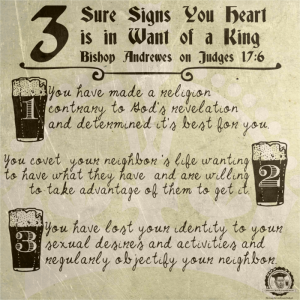
Andrews on Being in Want for a King in Judges 17:6
August 1, 2020
Sermon 8 of Lancelot Andrewes’ Certain Sermons Preached at Sundry Times upon Several Occasions before the King’s Majesty at Whitehall on March 24, 1606 roughly 4 months after the Gunpowder Plot to blow up King James I attempted on November 5, 1605
A copy can be found in Lancelot Andrewes Works, Sermons, Volume Five, pp.169-185, or on The Project Canterbury Website.
Sermon Summary:
Looking at the historical point of God’s people in which it became most clear of both their need for a king and God’s desire to establish one, Bishop Andrewes examines both the negative effects produced in the lives of men in women who are without a king (such as encouraging their propensity for misusing religion, liberty, and behavior), as well as the positive effects provided by having a king (especially in preventing idolatry and cultural syncretism). His outline is simple:
- Introduction
- Opening acknowledgements of both the blessing of now having a king, and the painful realization of their necessity when their seat in not filled
- Judges 17:6 and the others like it (18:1; 19:1; 21:25) begin to build anticipation in the mind of the reader for the Books of Kings
- Andrewes shows how kings were always a part of God’s perfect plan for His people (Deut.17:14-20)
- The Effects of Being in Want of a King
- Upon the eye (when individual perception is king)
- Upon the hand (no restraint but will and strength)
- Confusion wrought when both work together in rebellion (any man doing any thing)
- Remedy: 1) eye salve; 2) led by the hand; and then 3) hand restraint
- The Cause: Being in Want of a King
- No king to keep religion from idolatry, lives & goods in safety, and vessels in honor
- No king in Israel to keep the LORD’s Israel from becoming like the world’s Babel
- No kingly rule to govern and maintain the love of God and love of neighbor
- Conclusion
- Seven reasons to be thankful for having a King: 1) a King, 2) a singular King, 3) a local, non-foreign King, 4) a Christian King, 5) a wise King, 6) a King of peace, and 7) a King with a successor
Music & Sound Attributions:
Music in this episode by Blue Dot Sessions “Lost Shoe” (www.sessions.blue). Sounds used are as follows: “Beer Can Opening” recorded by Mike Koening found at (http://soundbible.com/216-Beer-Can-Opening.html), “Pouring Drink” recorded by Mike Koenig found at (http://soundbible.com/2115-Pouring-Drink.html), and “Time Warp” recorded by Mike Koenig found at (http://soundbible.com/978-Time-Warp.html)
Jul 17, 2020
Jul 17, 2020
1 hr 40 sec
Sermon 6 of Lancelot Andrewes’ Sermons of the Nativity preached before King James at Whitehall on Wednesday, December 25, 1611.
A copy can be found in Lancelot Andrewes Works, Sermons, Volume One or on The Project Canterbury Website.
If you do download a copy of the sermon from Project Canterbury note that the “Ô” and “Õ” symbols are equivalent to quotation marks and that some of non-modern English languages have not transcribed well.
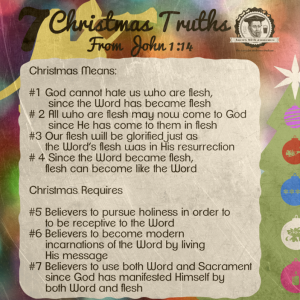
In this sermon, Andrews expounds upon St. John’s eye-witness testimony in 1:14 of how he, Peter, and James truly beheld the undeniable divine glory manifested by the Son, who is the living embodiment of the eternal Word (the nature, wisdom, and life of Yahweh), when Jesus altruistically full of grace and truth lovingly condescended to be made flesh (the vilest, weakest, and wound-able part of humanity) in order to abide with estranged humanity, to invade a world taken hostage ever since humanity’s fall, to serve as humanity’s champion in order to liberate them from their oppression, and to acceptingly adopt and truthfully transform humanity out of their empty state.
Although the first part of the sermon is somewhat difficult to follow, the outline laid out by Andrewes is very simple:
- Introduction: the nature of St. John’s Gospel
- The Mystery: The Word Became Flesh
- Significance of the words: “Word” “flesh” and “made”
- Significance of “glory,” “grace and truth,” and “full”
- The Benefit: What the Word did for Flesh
- 1: God cannot hate us who are flesh, since the Word has become our flesh.
- 2/Hope 1: All who are flesh may come to Him who has become flesh as they are.
- 3/Hope 2: As He restored His own flesh thru Resurrection, so He will do for His own.
- 4/Hope 3: Since the Word became like those of flesh, now those who are of flesh can begin the process of becoming like the Word (glorification/theosis).
- The Duty: What Flesh is to do for the Word, again
- Pursue Holiness: While the Word become our flesh, He kept it orderly and subdued allowing glory to be what seen in His living; so show those who received Him (receive Him not into a stable, but a decent and orderly home).
- Be an Incarnation: As Word became flesh for us, so we ought to incarnate His spoken word in our flesh for Him. And this we do not in fleeting spits and spurts of faithfulness, but in an abiding faithfulness that remains in all seasons.
- Use the Sacraments (Hope 4): As the Son has now chosen to communicate Himself by both natures of Word and Flesh, so we ought to receive Him by both: Word and Sacrament together.
- Conclusion: Christmas is the Feast celebrating the union between Word and Flesh, and by celebrating it we procure a dwelling for Him in our own lives wherein He may fill us with grace and truth.
Music & Sound Attributions:
Music in this episode by Blue Dot Sessions “Lost Shoe” (www.sessions.blue). Sounds used are as follows: “Beer Can Opening” recorded by Mike Koening found at (http://soundbible.com/216-Beer-Can-Opening.html), “Pouring Drink” recorded by Mike Koenig found at (http://soundbible.com/2115-Pouring-Drink.html), and “Time Warp” recorded by Mike Koenig found at (http://soundbible.com/978-Time-Warp.html)
Jun 22, 2020
Jun 22, 2020
1 hr 9 min
Sermon 1 in Lancelot Andrewes' Sermons on the Sending of the Holy Ghost Preached upon Whit-Sunday preached before the King's Majesty at Greenwich on June 8, 1606.
A copy can be found in Lancelot Andrewes Works, Sermons, Volume Three pp.107-129 or on The Project Canterbury Website.
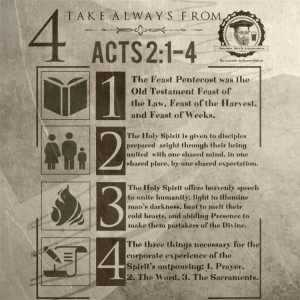
With this sermon, Bishop Andrewes examines the sending of the Holy Ghost as accounted by St. Luke in Acts 2:1-4, looking first at the time and manner of the Holy Spirit’s coming upon the Apostles and then concluding with the three things necessary for believers today to share in the blessing of the Spirit’s outpouring. The simple outline is as follows:
- Introduction of Acts 2:1-4 (Paragraphs 1-7; 8-16)
- The Time of the Spirit’s Coming (Paragraph 17)
- The Original day of His coming was known for the Feast of Pentecost; the Feast of the Law; the Feast of Harvest; and the Feast of Weeks (Paragraphs 18-22)
- St. Chrysostom saw this as the fulfillment of the Feast of harvest as the Apostles were putting their first sickle to the great harvest (Paragraph 21)
- St. Augustine say Pentecost [50th day] as a fulfillment of the Jubilee promise [50th year] forgiving debts and restoring men to their first estates (Paragraph 22)
- St. Cyril saw the emission of the Spirit at Pentecost as the renewal of what was lost by sin of the first emission of the Spirit into Adam whereby starting the process of the new creation (Paragraph 23)
- The Manner of the Spirit’s Coming
- The Disciple’s Part (Paragraphs 24-35)
- To whom the Spirit Came
- How they stood prepared
- How they were found framed and fitted to receive Him
- The Spirit’s Part (Paragraphs 36-93)
- How His coming was demonstrated by sounds and sights
- How it was explained by both:
- An inward filling by the Spirit’s truth, and
- Outward deeds of the manifestation of speaking in tongues.
- The Disciple’s Part (Paragraphs 24-35)
- Conclusion: Three things necessary to experience the outpouring of the Holy Spirit (Paragraphs 94-107)
- Prayer (cf.Acts 4:31)
- Word (cf.Acts 10:44, Apostle’s teaching)
- Sacrament (cf. Acts 19:6, laying on of hands/ see also breaking of bread 2:42-47)
Brews of the Week: Fr. Allen had a Vanilla Coffee Blonde (VCB) Ale by Cabarrus Brewing and Fr. Michael had his old faithful Guinness Draught

Jun 2, 2020
Jun 2, 2020
43 min
Why Andrewes?
Bishop Lancelot Andrews was a gifted preacher and translator of the Bible (without him the KJV Bible would not be what it is); a defender of the ancient, Biblical faith (without him the Anglican Church would not have bishops); an exemplary spiritual leader and man of prayer (leaving us his masterful “Spiritual Devotions”); and a practical Biblical theologian (as can be seen in his “A Pattern of Catechistical Doctrine”).
- Bishop Andrewes was Gifted Preacher and Translator (without him the KJV Bible would not be what it is)
- He was one of King James’ favorite preachers because of his eloquence
- He was the primary editor of the King James Bible’s Genesis-1&2 Kings and General Editor of the rest
- From Fr. Michael's Thesis, "Lancelot Andrewes' Life and Ministry": "A review of this work gives a great insight into the life and ministry of Andrews as it seems that ‘words’ are never enough when it comes to God” (p.21).
- He was one of the leading figures of the group of Anglican theologians and preachers known as the Caroline Divines.
- He was a Defender of the Ancient Faith (without him the Anglican Church would not have Bishops)
- Both practical and pastoral, Andrewes’ theology recorded in both his sermons and other works came to shape Anglicanism into what it is today, especially in regards to Bishops. As a Bishop, he saw himself not only as an “Anglican” bishop, but a Bishop in the One, Holy, Catholic, and Apostolic church. Being in continuity with early church was a necessity for Andrewes.
- Andrewes sought to be in communion with the Catholic Church in all times and all places and to return to the fundamentals of Christianity itself:
- Fr. Michael Thesis: “His prayer life, doctrine, and liturgy all shared a commonality of discipline, based upon scripture and early church tradition. He sough not new ideas and interpretations but the foundation of the early church” (p.1).
- “He understood that the Reformation was necessary because of the corruption of the Roman Church and believed that the new direction should be guided by a return to the practices and doctrines of the early church enshrined by the first four councils” (p.12).
- “The Christian faith as explained by Andrews, is ‘one cannon given of God, two testaments, three symbols (Apostles’, Nicene, and Athanasian Creeds), the four first councils (of Nicaea I: 325; Constantinople I: 381; Ephesus: 431; Chalcedon: 451), and first five centuries and the series of Fathers therein” (p.13).
- He promoted “the idea of Catholicism that was episcopal, but not papal” (p.15).
- “Andrewes decided to look backwards in order to move forward. As the Church has always had its divisions and heresies, he searched the ‘ancient Fathers and lights of the Church, in whom the scent of this ointment was fresh, and the temper true on whose writings it lieth thick and thence strike it off and gather it safely’” (p.77).
- He wanted to restore the original practices of Christ and the church
- Fr.Michael Thesis: “If something such as the cross, was abused to superstition in time of popery, it must have been well used before that time. Thus, the abuse of the Pope did not make something that was good and proper become something unsavory of itself” (p.20).
- Responding apologetically to Cardinal Bellermine’s Responsio ad Librum: Triplici nodo, triplex cuneus (1608) Andrewes “continues a theme of walking a path which the early fathers of the church traveled” (p.60).
- “Andrews argued against Cardinal Bellermine that it was the Roman Catholic Church who had changed the early church teaching thus contracting ‘much filth’ that caused much suffering for those of the catholic faith. By changing the sacraments and their meanings, the Roman Church had been the ones who were innovating and Andrewes argued that it was the Anglican Church who renovated what was customary with the ancients (The early Church) (p.99).
- He was a monumental Spiritual Leader and Man of Prayer (Spiritual Devotions)
- Fr. Michael Thesis: “Lancelot Andrewes helped guide the Church of England during the early post-Reformation period. He is famous for both his prayers and his sermons as they reflect holiness of life” (p.2).
- His now-published devotions have modeled how to both pray the Scriptures as well as draw close to Jesus.
- Fr. Michael Thesis: “The example-of-Christ theme has been used by others as a guide by other Anglicans; for if the Lord does, so should his followers. The command to “pray” came from Jesus thus it is not a choice to make, by telling all to ‘pray’ it is Jesus that binds us to prayer. It is not an option” (p.35). “Andrewes’ adherence to the Daily Offices of Morning and Evening Prayer” grows out of this observation (p.97).
- “As revealed in his sermons on the Lord’s Prayer, Andrewes believed that prayers should be structured” (p.85).
- “Andrewes links prayer with fasting and alms giving: and these three to offer to God our soul by prayer our body by abstinence and (thirdly) our goods by alms, deeds had been ever counted the triple or threefold” (p.86)
- T.S. Eliot came to love Andrewes for his spiritual writings and considered him somewhat of a spiritual mentor. In his later poetry, Eliot quotes Andrewes more than any other source and said that Andrewes’ English Catholicism was the only form of Anglicanism he wanted to espouse.
- He strove to see his neighbor as God made them, rather than seeing their sin-made selves
- Fr. Michael Thesis: “Take heed we take not the sin of our neighbor for our neighbor, for every sinner, as he is a sinner, is to be hated; every man, as he is man, is to be loved: let us love men so that we love not their sins, and love them for that which God made them, not that which by sin (the breaking of the Commandments) they made themselves” (p.51).
- He was a Practical Biblical Theologian (A Pattern of Catechistical Doctrine; and Real Presence in Ad Apolgiam Cardinalis Bellarmini)
- His doctrine of the Incarnation is always front and center and occupies the largest part of his theology: In Christ, man and God were united which paved the way for our reconciliation and union with God. Participation in the divine Nature was the ultimate end-state of the Incarnation.
- Fr. Michael Thesis: “Andrewes’ doctrine [of the Eucharist] could be described as the Word flowing into and through the Eucharist feeding all who partake of it worthily… Andrewes has a high view of the Eucharist and of the real presence of Christ” (p.67,68).
- “He viewed the Eucharist not only as a communion between those with the Church, but also as a communion of unity between God and Man” (p.90).
- “The kernel of grace is planted in us by the participation of the body and the blood of Christ; of which kernel comets a tree, which bringeth forth the fruits of holiness and righteousness in our whole life… Which God will in due time reward with the Crown of life and glory in the world to come” (p.91).
- “Although he confirmed the two sacraments given by Christ, he did not dismiss the other five sacraments of the Anglican Church” (Holy Unction, Confirmation, Confession, Holy Orders, Holy Matrimony) (p.91).
- He had a High view of the Holy Spirit: Through the Holy Spirit Christ was conceived, the Church is constituted, and Christ’s presence is communicated to us in the Sacraments
- Fr. Michael Thesis: “Anselm decades earlier had tried to describe God (the ontological debate), but Andrewes would always strive to make God as personal as possible in his sermons, prayer life, and liturgy as a way of encouraging people to come to Him” (p.21).
- “Andrewes’ life implies that he believed that all senses must be on Christ, not just ears as of hearing a sermon, and by thus doing so be drawn near to Him in worship” (p.63).
- “To be ‘truly called in the heart,’ according to Andrewes there must be an urging, a motivating desire, a love of godliness and even a hatred of sin within one’s whole self” (p.83).
- “He did not invent doctrine but relied on the scripture, allowing the scripture to speak of itself as interpreted by Christ’s Church” (p.42).
Fr. Michael's Thesis: "Lancelot Andrewes' Life and Ministry"
Music & Sound Attributions:
Music in this episode by Blue Dot Sessions “Lost Shoe” (www.sessions.blue). Sounds used are as follows: “Beer Can Opening” recorded by Mike Koening found at (http://soundbible.com/216-Beer-Can-Opening.html) and “Pouring Drink” recorded by Mike Koenig found at (http://soundbible.com/2115-Pouring-Drink.html)